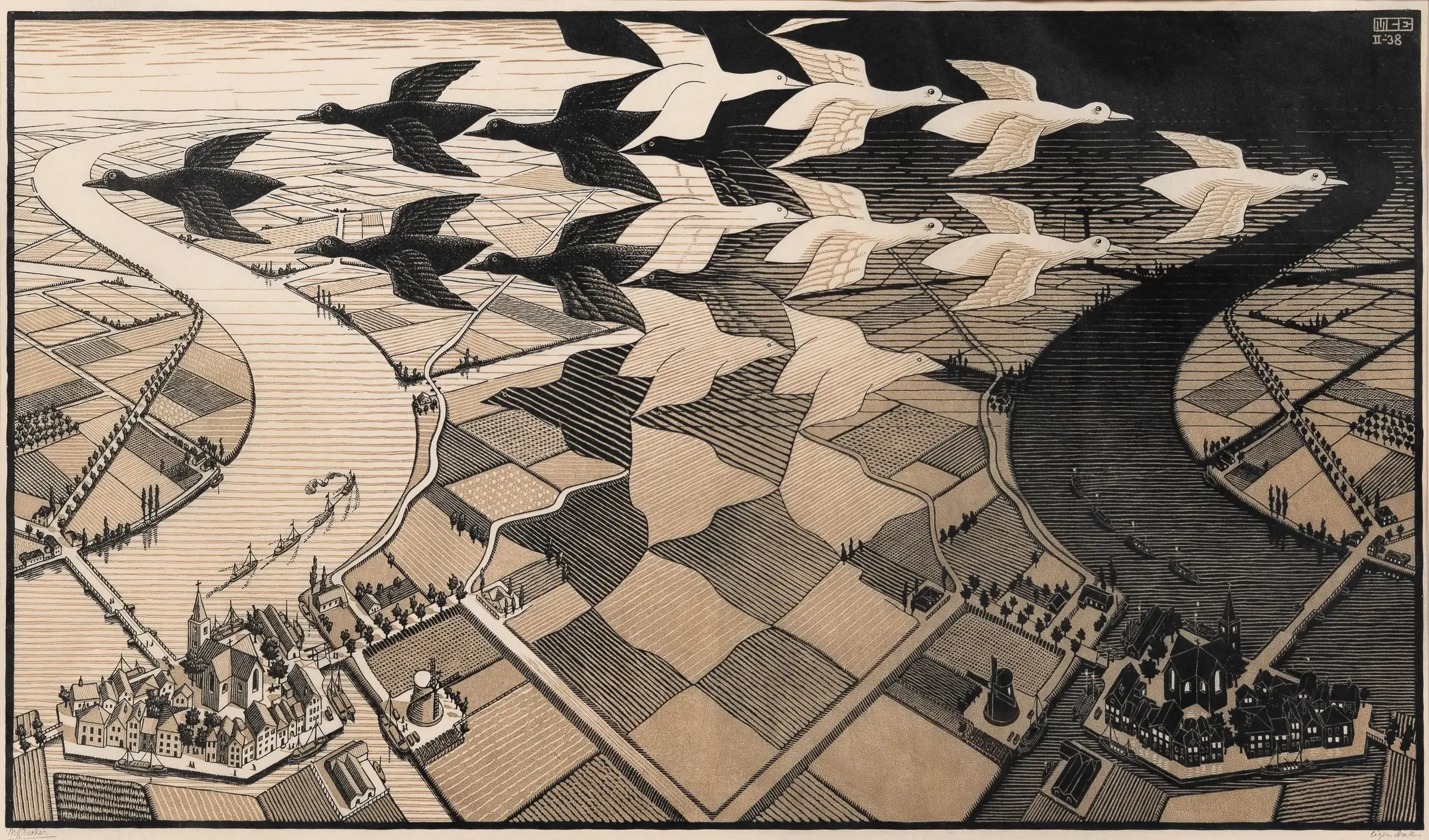
A Midwinter Night’s Dream
Walking with friends in below freezing temperatures can be fun—unless your friend forgets his coat, just as mine did. His hands were turning bright red, and as it was late there were few places still open to warm up in. For us, two sixteen year olds, a bar might not be our normal stomping grounds, but that night was an exception. We swung in, and for some reason they let us stay until my friends hands warmed up so that they didn’t fall off. What did we do in the back of a bar for 15 minutes? Not fighting, not drinking, but rather mathing!
The Problem
Alright lets get started with the prerequisite: the triangle numbers.

Ok so those are the triangle numbers, hopefully that diagram makes sense. Let’s write a formula for these numbers: .
Sure, now let’s try to simplify this into something more algebraic. For example, let’s try for , . Now how do we sum them? Luckily some old mathematician named Gauss has an answer!
If you want a way to visualize this, imagine lining up 5 and 1, 4 and 2, 3 and 3, etc. No matter what the sum of the two numbers will be 6. Since we added two of our sums together, we just need to divide by two to find our answer.
Now we can finally get started on the problem itself!
The Problem (cont.)
So what are we trying to do? Well I think you’ll find this amusing:
Ok. Let’s get to work solving it. As I always like to do when solving problems with infinite sums, lets write out a few terms and see if we can find a pattern.
And just trust me here:
Now, before you continue reading, I invite you to look for the pattern yourself. I do warn, it’s not easy to spot!
Alright, heres the solution:
If you want a more rigorous reason of why this is the case, I want you to do it yourself! Here’s a hint: use partial fraction decomposition.
And finally, what is it equal to? Well we can cancel every fraction with the one following it, so we are left with…
And to finish it off,
Now none of this math was proven, and there was minimal explanation. I hope you try going at the more rigorous approach I mentioned above, since it is actually quite entertaining. To sum it all up, patterns are always one of the most unexpectedly amazing parts of math.
Have fun out there,
Ilan Bernstein